The demand for expensive gourmet coffee, as well as the high real estate prices in and around Boquete has forced some coffee growers in Chiriqui to encroach on protected park land. The ‘geisha’ coffee varietal, which is grown in the highlands near the border between Panama and Costa Rica, is considered to be the ‘champagne’ of coffee beans, with some growers fetching up to $130 per pound wholesale. A recent article published by Reuters says that while the current encroachment into Volcan Baru National Park is a relatively small fraction of the large park, the plantations threaten local biodiversity, a threat that is likely to increase given the high demand in North America for specialty coffees, and the rising real estate prices in the lower elevation areas of Chiriqui.
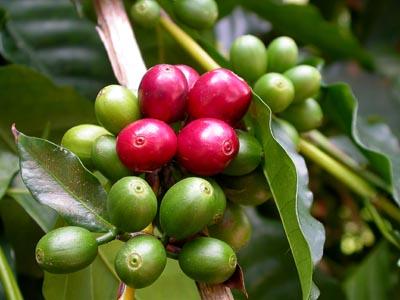
Traditional coffee farms operate under a canopy of trees, which can provide refuge for birds and animals, as well as supply the farmer with supplemental fruits and other beneficial products
From an environmental standpoint, coffee can be a tough issue to grapple with. As one of the most important agricultural commodities, it has a huge impact on many people, from the growers in Central America, Africa and Indonesia, to the Barista that pulled the shot of espresso for your latte this morning. It also has a major impact on wildlife. Large commercial coffee plantations, or sun plantations, often clear-cut habitat that would otherwise be the home of thousands of organisms, including many familiar bird species that migrate to North America in the summer.
Yet coffee trees are naturally shade loving plants, and shade grown coffee beans are naturally superior in taste to their sun grown brethren. Traditional coffee farms operate under a canopy of trees, which can provide refuge for birds and animals, as well as supply the farmer with supplemental fruits and other beneficial products. Many farmers in Central America still grow coffee in this manner, including many of those that produce the highest quality beans in Panama.
Regrettably it can be extremely difficult for consumers to differentiate between the ‘good’ coffee, and the ‘bad’ coffee. One of the most useful ways is to seek out coffee that is certified by a third party as shade grown, organic, and/or fair trade (and example being the Smithsonian Migratory Bird Center’s “Bird Friendly” label). Unfortunately not all certification processes are equal (the Rainforest Alliance’s certification has lower standards than Smithsonian), not all uncertified products are bad (as the certification process can be expensive and prohibitive to small scale farmers) and coffee that is certified organic is not necessarily shade grown or fair trade, and vice-versa.
The take home message from all of this is, as consumers, simply to be cognizant of where your coffee comes from, and what potential impact it may have on the people that produce it, and the wildlife that is affected by it. In addition to this, as real estate investors in Panama, it is important to be aware of the effects that higher real estate can have on local farmers. Invest in the local community, in local farms, and by purchasing sustainably grown local products.
For more information on shade-grown coffee, visit Seattle Audubon’s Shade Coffee Campaign website.


Thanks for bringing attention to the issue of Volcan Baru National Park. But your comment about the Rainforest Alliance Certified standards is bothersome. Why would you say that? FYI: the Rainforest Alliance is a member of the International Social and Environmental Accreditation and Labelling Alliance; many certification organizations are not.
Thank you very much for pointing this out. I did not mean to insinuate that the Rainforest Alliance’s certification program is in any way ‘bad,’ it just follows a different set of standards than the Smithsonian Migratory Bird Center’s shade coffee certification program. For instance, the Rainforest Alliance program does not require that the coffee be grown organically, and allows for farms to be certified as ’shade grown’ in areas where the original ecosystem was not necessarily a forest (which can result in coffee plantations ’shaded’ by a monoculture of trees), tactics the organization uses to gain a broader support from farmers that may be less likely to accept these standards. The SMBC certification process on the other hand requires farmers first to cultivate coffee organically, as well as levies fees on the roasters and retailers (not just the farmers) to provide research funds to the institute’s Migratory Bird Center.
From a bird conservation standpoint, the SMBC program is a better program, as it promotes rustic shade coffee plantations (which have much higher levels of biodiversity than other types of shade plantations) more so than the Rainforest Alliance’s program.
For more information, visit http://shadecoffee.org/shadecoffee/BuyCoffee/CoffeeCertification.aspx or http://nationalzoo.si.edu/ConservationAndScience/MigratoryBirds/Coffee/certification_evaluation.cfm (I do realize that the last link comes directly from the SMBC website, yet the article itself is citing research from a peer reviewed journal).
Thanks for your concern!